As a young pilot in the Navy I flew a couple different aircraft that had extremely complex electrical systems. Understanding them was daunting: silicon control relays, transformer rectifiers, this bus, that bus….I truly hated studying it, and felt like I never mastered them.
At one point I was selected to be a Fleet Replacement Squadron Instructor and with that came the responsibility to teach a system in ground school. I was given the choice of systems! Anyone with military experience knows that you are RARELY given a choice in anything. So I chose the electrical system. Party! I was frustrated that electrics was whipping my butt and wanted to de-mystify the whole thing: for myself, and maybe for some new pilots coming along.
About two years into owning Sandavore I began to suspect that it was time to change the house battery bank out. There were eight 12V Trojan lead acid batteries wired in series (positive to negative). These batteries were designed as “Deep Cycle”, meaning that they are intended to be completely discharged and recharged on a regular basis. However some things seemed amiss: the battery bank began to discharge rather quickly, and when being recharged I could hear them faintly boiling. I had to frequently top off the batteries with distilled water. And I began to notice that the batteries were bulging slightly at the terminals. Hmmm.
A call to Mark @ Mark’s Marine led me down the path of battery school. “Trojans, ah. How old are they?” “Seems like they are from 2007.” “Well, ha ha, I’m surprised they have lasted this long. Are they boiling?” “Yep.” “OK I need to come see them as soon as possible. It sounds like we gotta get those out.”
What I learned from him is that, when traditional lead acid battery banks fail (and are on a charging system), it can turn into a dangerous situation. The lead plates begin to corrode and open, placing physical pressure on the plastic battery case. In the worst instance the case (already hot from trying to maintain voltage) splits, causing contact, arcing, and a fire. At a minimum there will be a battery acid fountain in the battery box and a gigantic mess.
To make matters worse, the house bank was being used as the power source for the bow thruster. Deep cycle batteries are not well suited to instantaneous, high amperage load requirements. Also, as the batteries began to fail, the low amperage could have caused the bow thruster motor to heat up due to inefficiency.
The decision was made to install Absorbed Glass Mat (AGM) batteries, however in two, separate banks: one Deep Cycle bank for the house battery system, and one Start Cycle bank dedicated to the bow thruster. I was away during the time that Mark and Keith removed and replaced the batteries, but I watched some of the work from the wireless security cameras mounted on board. It was backbreaking, I assure you! Hauling multiple 80 pound batteries on board, inside the pilothouse, and down into the engine room. Removing the old lead acid batteries was slightly easier however they were concerned that any of them might burst open at any point.
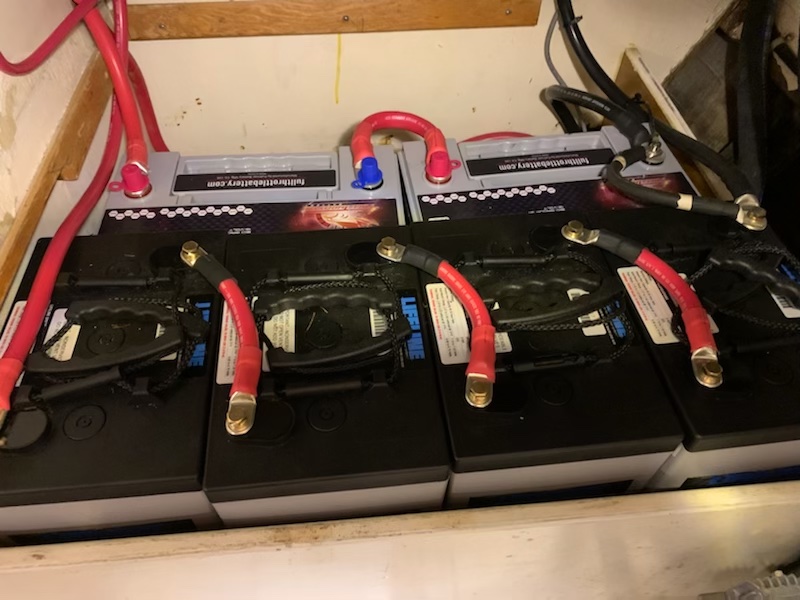
Separating the banks necessitated the install of a dedicated digital battery charging relay for the Start Cycle batteries.
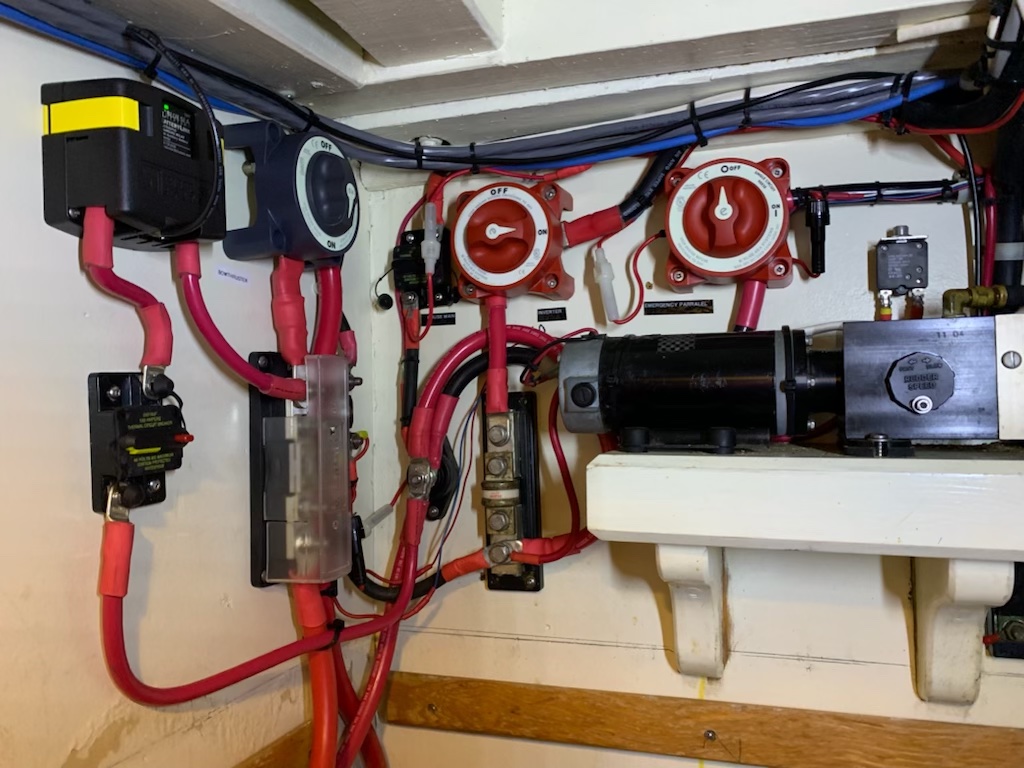
I recently tested the bow thruster- it virtually jumps! Literally didn’t realize how much difference it would make. This will significantly improve close-quarters navigation. Thanks to Mark for the electrical system ground school and battery improvements!